Around 30,000 British nationals have already made Cyprus their home — and it’s easy to see why. Sunlit coastlines, lower cost of living, a familiar language, and a tax‑friendly regime make for a compelling escape.
UK citizens can buy property in Cyprus and gain lifelong permanent residence — no need for temporary permits. From hilltop villages to Limassol seafronts, settling down is simple.
Discover how to make the move.

Why are British nationals moving to Cyprus?
Around 20% of foreigners move to Cyprus to retire, and 19% seek a better quality of life, according to the Expat Insider Survey 2025[1]. With its Mediterranean climate, strong tourism, and growing business sector, Cyprus attracts a wide range of people — from investors and entrepreneurs to young professionals, retirees, and families.
1. Life-long residence from the outset
Cyprus Permanent Residence is an attractive opportunity for investors looking to settle long-term[2]. By investing at least €300,000, it’s possible to gain lifetime residency — with the only formality being the renewal of the residence card every 10 years.
One of the most popular investment routes is purchasing real estate, which not only secures residency but also provides the chance to own property on a warm Mediterranean island and benefit from potential rental income or capital growth.
2. Low cost of living
The overall cost of living in Cyprus is about 30% lower than in the UK[3].
The biggest difference is rent: a family in Cyprus spends around €1,600 per month, while a comparable apartment in the UK costs about €2,500. Transport is also significantly cheaper — by nearly 70% — thanks to lower fuel prices and modest public transport costs.
Food expenses, however, are roughly the same in both countries.
3. Thriving business landscape
Cyprus draws British entrepreneurs and professionals with its attractive corporate tax rate of just 12.5%, one of the lowest in the EU. There’s also 0% withholding tax on most outbound dividends, interest, and royalties, and no capital gains tax on the disposal of shares.
For IP-rich companies[4], the 80% exemption on qualifying intellectual property income means an effective tax rate of around 2.5%[5].
These fiscal benefits have helped Cyprus become a centre of gravity for several fast‑growing industries:
- Shipping is a powerhouse: Cyprus manages over 20% of the world’s third‑party ship‑managed fleet, making it among the top three in Europe and 11th globally[6].
- The tech sector now contributes around 16% of the country’s GVA, with Cyprus attracting SaaS, gaming, and adtech firms[7].
- The investment fund industry continues to grow, reaching €10.1 billion in assets under management in 2024[8].
- Tourism generated €3.2 billion in revenue in 2024, buoyed by more than 4 million international arrivals[9].
4. Favourable tax regime
The UK and Cyprus have signed a double-tax treaty, which helps prevent double taxation and clarifies taxing rights on income and capital gains — handy for cross-border earners and retirees[10].
UK nationals can also benefit from Cyprus’s non-domiciled tax regime[11]. If they become tax residents but are considered non-domiciled, they are exempt from paying the Special Defence Contribution, SDC, on dividends and most passive interest. Even rental income is free from SDC for non-doms. This exemption lasts for 17 years.
5. Strong property market
Real estate in Cyprus remains competitively priced, with the national average at approximately €2,600 per 1 m², around 40 to 50% lower than in the UK[12].
Real estate affordability continues to attract foreign buyers, who completed 6,228 transactions in 2024. The majority of purchases were concentrated in Paphos, 32%, and Limassol, 29%, with 69% of foreign buyers coming from outside the EU[13].
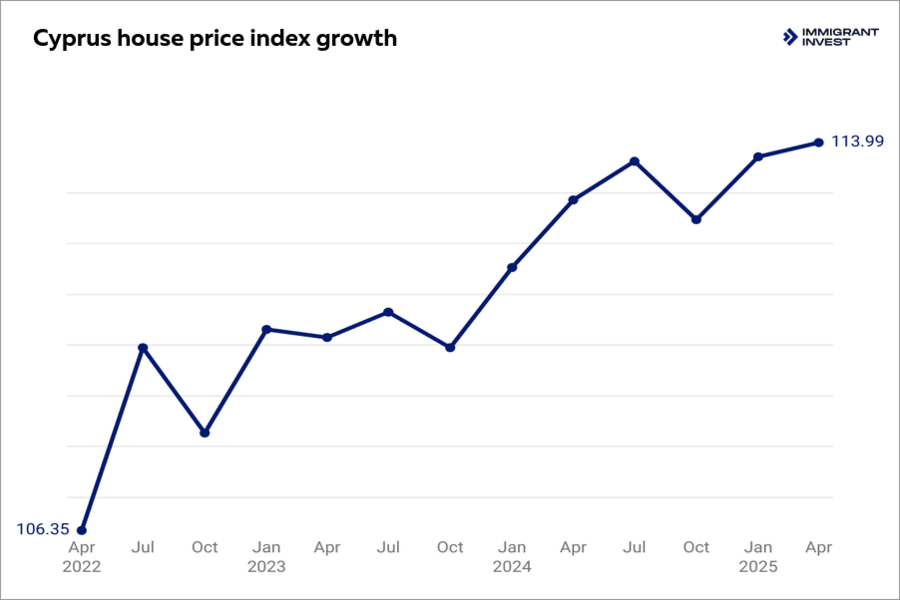
Permanent residence holders in Cyprus may lease their properties long-term, earning an average gross yield of 5.09% as of the third quarter of 2025[14]. Alongside rental income, properties continue to appreciate in value, with residential prices up 7% year‑on‑year by late 2024[15].
6. Safe environment
Cyprus is considered a safe place to live, supported by Eurostat’s 2023 data showing one of the lowest homicide rates in the EU, at just 0.8 per 100,000 people[16].
Healthcare is another key strength. Cyprus ranks 4th globally for healthcare services in the Expat Insider Survey 2025. Expats rated the system highly for its affordability, availability, quality, and equal access.
The island also poses minimal risk from wildlife. While a few potentially dangerous species exist, threats are rare, localised, and well managed.
7. Top-tier international schools
UK nationals can access international schools in Cyprus offering the British curriculum. Leading institutions include PASCAL English School Lemesos and Silverline Private School in Limassol, with annual tuition ranging between €8,300 — 13,200 and €3,520 — 7,800, respectively.
In Paphos and Nicosia, British schools follow the English national curriculum from early years to sixth form, preparing students for IGCSEs and A-levels.
8. Established expat networks
Almost 260,000 foreign-born residents live in Cyprus, which is around 27% of the total population[17]. Among these, about 30,000 are British nationals. Other notable non‑EU communities include Filipinos, Sri Lankans, and Vietnamese.
Cyprus ranks among the top 10 countries worldwide for ease of settling in, according to the Expat Insider Survey 2025. Expat communities like InterNations help make integration smoother thanks to regular events and interest groups for newcomers. Other options include Meetup groups and local forums such as Paphos Life and Expat.com.
9. Familiar daily comforts
For British nationals settling in Cyprus, a range of familiar comforts makes the transition remarkably smooth. Driving follows the left-hand rule, and Type G plugs are standard. English is widely used across public services.
British media is also readily available: BBC, ITV, and Sky channels can be accessed through local IPTV providers, while newspapers such as The Times and The Guardian are easy to find both online and at kiosks in popular expat areas.
10. Relaxed coastal lifestyle
For UK nationals, Cyprus offers more than sunshine — it offers rhythm. Life here moves with the coast, where cities like Larnaca, Paphos, and Limassol stretch out along the sea, framed by citrus groves and salt air.
The average temperature hovers around +24°C, with winters so mild and skies so steady that outdoor living never really stops. One morning might mean coffee by the beach, the next a hike through pine-covered Troodos mountains or a swim in Limni lake.